Blog · 12 Nov 2026
Calculating overtime and Sunday work under the Working Hours Act – examples
Overtime is often calculated incorrectly for two reasons: daily overtime is also counted as weekly overtime, or the tiers of the old Working Hours Act are used for weekly overtime. Here are the rules under the current Working Hours Act (872/2019).
Regular working hours
Under section 5 of the Working Hours Act, regular working hours are at most 8 hours per day and 40 hours per week. Weekly working hours can also be arranged as an average of 40 hours over a period of up to 52 weeks. Many collective agreements define regular working hours differently, for example 37.5 hours per week.
Overtime compensation (Working Hours Act, section 20)
| Situation | Compensation |
|---|---|
| Daily overtime, first 2 hours | +50 % |
| Daily overtime, following hours | +100 % |
| Weekly overtime | +50 % |
| Period-based work, 2-week period: first 12 overtime hours / 3-week period: first 18 | +50%, then +100% |
| Sunday work (also church holidays, Independence Day and May Day) | +100 % |
Note: the current Working Hours Act does not tier weekly overtime. The old act's rule "first 8 hours at 50%, then 100%" still lives on in many collective agreements – in that case, the collective agreement is followed.
Example: one working week
| Day | Working hours | Hours | Note |
|---|---|---|---|
| Mon | 7:00–18:00, lunch 30 min | 10.5 h | 8 h + 2.5 h daily overtime |
| Tue–Fri | 7:00–15:30, lunch 30 min | 4 × 8 h | |
| Sat | 8.00–14.00 | 6 h | exceeds 40 h per week |
| Sun | 10.00–12.00 | 2 h | Sunday work + weekly overtime |
Calculation under the Working Hours Act:
- Daily overtime on Monday 2.5 h: 2 h +50% and 0.5 h +100%.
- Weekly overtime: 8 + 32 = 40 h of regular work accumulate before Saturday. Saturday's 6 h and Sunday's 2 h are weekly overtime: 8 h +50%. Monday's daily overtime is not counted a second time.
- Sunday work 2 h: +100%, and because the hours are also overtime, overtime compensation is paid on top, calculated from the base wage.
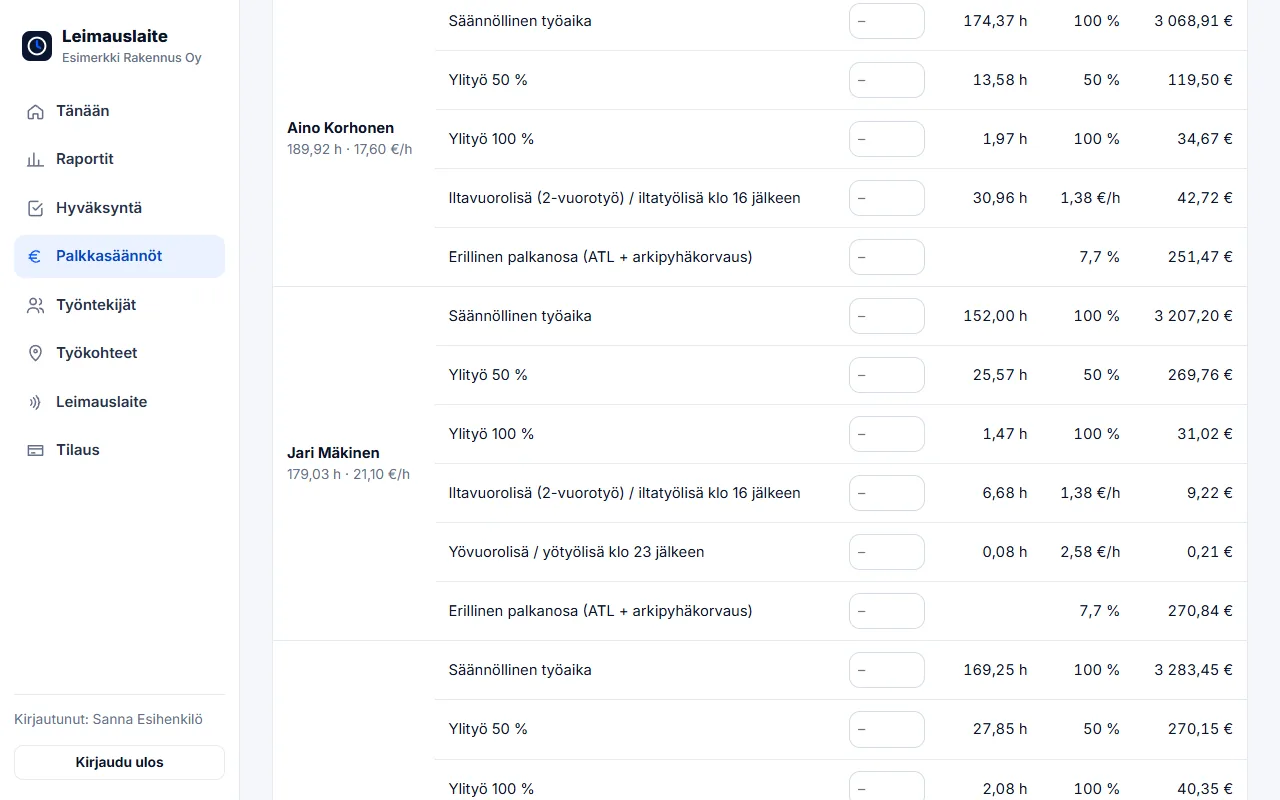
Total: regular working hours 40 h, overtime 50% 10 h, overtime 100% 0.5 h and Sunday work 2 h. These are exactly the figures the app calculates from clock-ins – you can check them in the Pay types report.
Public holidays are taken from the calendar
The Sunday work increment also applies to church holidays: New Year's Day, Epiphany, Good Friday, Easter Sunday, Easter Monday, Ascension Day, Whit Sunday, Midsummer Day, All Saints' Day, Christmas Day and St Stephen's Day – as well as Independence Day and May Day. The app calculates the movable holidays (Easter, Ascension Day, Midsummer, All Saints' Day) automatically.
FAQ
Is daily overtime also counted as weekly overtime?
No. Hours compensated as daily overtime are not counted again as weekly overtime.
How much is paid for weekly overtime?
Under section 20 of the Working Hours Act, weekly overtime is paid at a 50 percent increased rate. In many collective agreements, the first 8 hours are paid at 50% and the following hours at 100% increased rates.
How much is paid for Sunday work?
Sunday work is paid at a 100 percent increased rate. If the work is also overtime, overtime compensation is paid as well.
Read also
- Collective agreement rules in time tracking: pay types straight from clock-ins
- Approving and locking working hours: how to close a period correctly
- Evening, night and Saturday supplements 2026: 20 collective agreements compared
- Email reminders and invitations: a forgotten clock-in no longer surprises you on payday
- Annual leave accrual and flexitime balance: how the app calculates them by law
- Part-timers, additional work and mid-week public holidays: working hours per employee
- Old timesheets, opening balances and support: how to switch time tracking systems
- Clocking in with phone NFC, five languages and a login for your accounting firm
- Shift roster under the Working Hours Act: create, publish and compare with actual hours
- Building-site personnel list and employee report to the Finnish Tax Administration directly from clock-ins
- Mileage allowance and daily allowances 2026: trips and expenses in time tracking
- Kiosk mode, projects and billing by site – and security in order
- Time tracking in staffing: hours by client for billing and payroll
- Time tracking in construction: Valtti card, building sites and the construction collective agreement
- Time tracking in cleaning: NFC tags at sites and hours by site
- Time tracking in property maintenance: tags in properties and on-call duty made visible
- Time tracking in retail: evening and Saturday supplements under the retail collective agreement
- Time tracking in restaurants: night shifts, period-based work and the MaRa collective agreement
- Time tracking in care and home services: percentage supplements and public holidays done right
- Time tracking in industry and warehouses: shifts, overtime tiers and collective agreements
- Time tracking in the office: flexitime, remote days, leave and the accounting firm
- Time tracking in transport and logistics: period-based work and terminal shifts
- Time tracking in security services: night shifts, public holidays and period-based work
Try it for free – 1–3 employees always free of charge
Add employees and work sites, choose the entry method and the hours start adding up. No card details, no commitment.